
The 8th Pay Commission is one of the most awaited developments for central government employees and pensioners in India. Every Pay Commission plays a key role in revising salary structure, allowances, and pension benefits for lakhs of people.
At present, many employees are searching for clear answers. Questions like when the 8th Pay Commission will be implemented, how much salary hike is expected, and what the fitment factor may be are being widely discussed. However, mixed media reports and unofficial claims have created a lot of confusion.
In this article, you will find clear, factual, and easy-to-understand information about the 8th Pay Commission. We cover its meaning, latest updates, expected timeline, fitment factor, salary impact, allowances, pension changes, and important points every employee should know.
In This Article
What is the 8th Pay Commission?
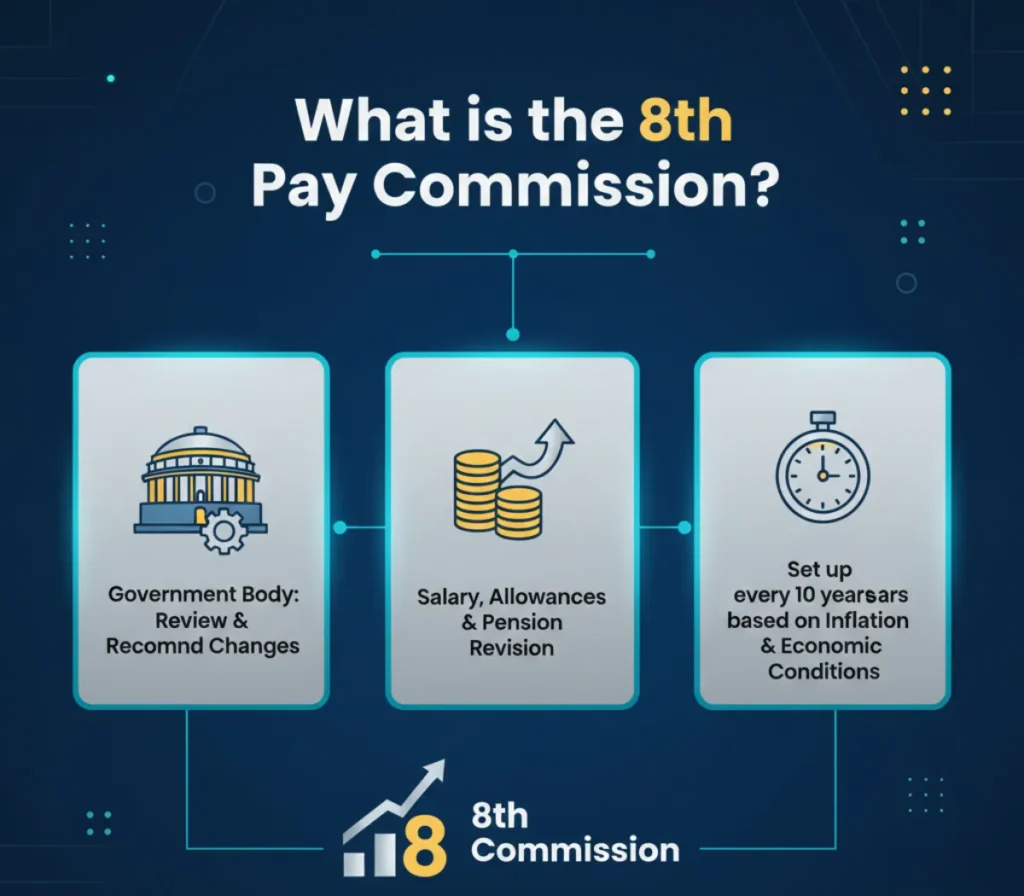
The 8th Pay Commission is a proposed government body that will review and recommend changes in salary, allowances, and pension of central government employees and pensioners.
In India, the central government sets up a Pay Commission roughly every 10 years. Its main work is to study the existing pay structure and suggest improvements based on inflation, cost of living, and economic conditions.
Why is a Pay Commission important?
A Pay Commission affects the financial life of employees in many ways:
- Revision of Basic Pay
- Changes in Pay Matrix
- Increase or modification in Allowances
- Pension revision for retired employees
Once the recommendations are approved by the government, they are implemented across all central government departments.
Short look at the previous Pay Commission
| Pay Commission | Implemented From |
|---|---|
| 6th Pay Commission | 1 January 2006 |
| 7th Pay Commission | 1 January 2016 |
| 8th Pay Commission | Expected after 7th CPC |
The 7th Pay Commission brought a new pay matrix system and a fitment factor of 2.57. Because of this, employees are now expecting similar or better changes from the 8th Pay Commission.
Latest News & Current Status of 8th Pay Commission
Right now, the 8th Pay Commission is one of the most discussed topics among central government employees. However, it is important to understand the difference between official updates and media speculation.
As of now, the central government has not officially announced the full implementation details of the 8th Pay Commission. No final notification related to salary hike, fitment factor, or new pay matrix has been issued yet.
What has the government said so far?
- The government has not denied the possibility of the 8th Pay Commission
- But no confirmed date for implementation has been notified
- Salary revision will happen only after official approval and notification
Why is there confusion?
Many news websites and social media posts are claiming:
- Salary hike from a fixed date
- Confirm fitment factor numbers
- DA merger with basic pay
In reality, most of these claims are not officially confirmed. Employees should rely only on government notifications, not viral news or YouTube rumours.
Current situation in simple words
- The 8th Pay Commission is under discussion stage
- No final structure is approved yet
- Employees will get clear information only after the official announcement
Expected Timeline of the 8th Pay Commission
Most central government employees want to know when the 8th Pay Commission will be implemented. At present, the exact date is not officially confirmed.
However, based on the pattern of previous Pay Commissions, an expected timeline can be understood.
How the Pay Commission timeline usually works
Generally, the process of a Pay Commission follows these stages:
- Constitution or announcement of the Pay Commission
- Appointment of the Chairman and members
- Data collection from government departments and staff unions
- Submission of the final report
- Cabinet review and approval
- Implementation through an official government notification
Expected timeline (based on past trends)
| Stage | Expected Time |
|---|---|
| Constitution of the 8th Pay Commission | Around 2025–26 |
| Report Submission | 18–24 months after formation |
| Government Approval | After the report review |
| Implementation | After approval, with possible arrears |
Important: This timeline is only a trend-based estimate. Final dates will depend entirely on official government notifications.
Possible implementation year
The 7th Pay Commission was implemented from 1 January 2016. Following the usual 10-year cycle, many experts believe that the 8th Pay Commission may come into effect around 2026.
However, any salary increase will be applicable only after official approval, even if a retrospective date is announced.
Expected Salary Hike After the 8th Pay Commission
The main reason employees are waiting for the 8th Pay Commission is the expected salary increase. A new Pay Commission usually brings a revision in basic pay, which directly affects the overall salary.
The actual salary hike will depend on the fitment factor, new pay matrix, and revised allowances. Without official approval, exact figures cannot be confirmed yet.
How salary increase usually happens
When a Pay Commission is implemented, salary increases through:
- Revision of Basic Pay
- New Pay Matrix levels
- Changes in allowances like DA, HRA, and TA
Even a small increase in basic pay creates a noticeable rise in monthly in-hand salary.
Expected level of salary hike
Based on previous Pay Commissions:
- Salary hike is generally moderate but structured
- The increase is higher for lower pay levels
- Overall growth also depends on DA at the time of implementation
At present, any percentage or amount being shared online is not officially confirmed.
Impact on Allowances After the 8th Pay Commission
Allowances play a major role in the take-home salary of government employees. Any Pay Commission not only revises basic pay but also reviews existing allowances.
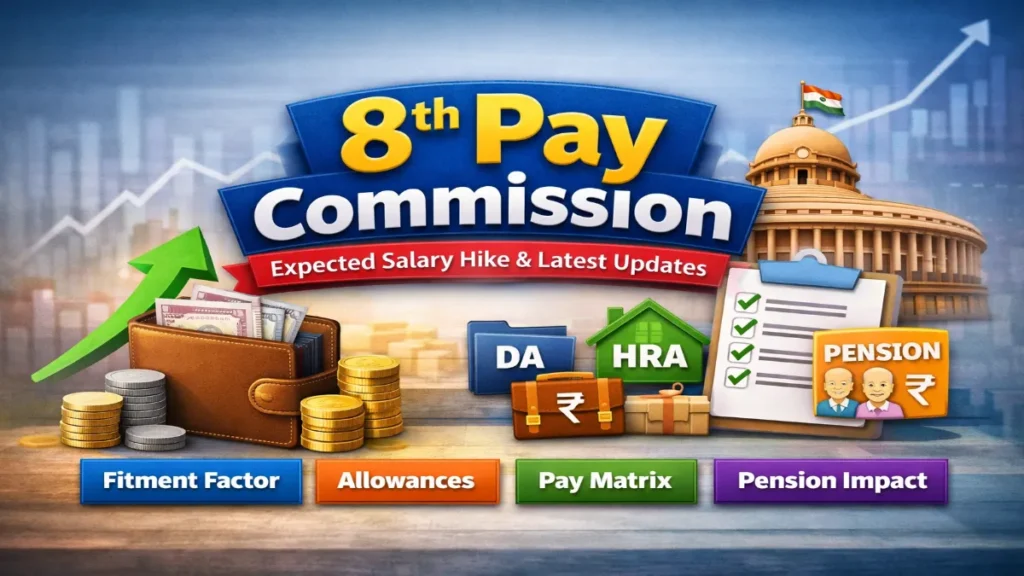
The 8th Pay Commission is expected to examine important allowances like Dearness Allowance (DA), House Rent Allowance (HRA), and Transport Allowance (TA).
Dearness Allowance (DA)
DA is revised twice a year based on inflation. After the implementation of a new Pay Commission, DA is usually reset to zero and then starts increasing again.
There are many rumours about the merger of DA with basic pay, but as of now, there is no official confirmation regarding the DA merger.
House Rent Allowance (HRA)
HRA depends on the city category where an employee is posted. When basic pay increases, the HRA amount also increases automatically, even if the percentage remains the same.
The 8th Pay Commission may review HRA rates, but any change will be announced only through official orders.
Transport Allowance (TA)
Transport Allowance is provided to cover daily commuting expenses. It may be revised or restructured based on pay level and location.
Any increase in TA will directly improve the monthly in-hand salary.
Key takeaway
Changes in allowances can sometimes have more impact than a basic pay increase. Employees should wait for official notifications before trusting online claims.
8th Pay Commission and Pensioners
Pensioners are also direct beneficiaries of every Pay Commission. Any revision in pay structure usually leads to pension revision for retired employees.
The 8th Pay Commission is expected to review pension rules for both existing and future pensioners.
Pension revision
When a new Pay Commission is implemented, pension is generally revised based on the last drawn pay or the revised pay matrix.
This helps maintain parity between serving employees and retired pensioners.
Impact on old pensioners
Old pensioners, especially those retired before the 7th Pay Commission, may see a revision in basic pension.
In many cases, pensioners also receive arrears, depending on the effective date fixed by the government.
Dearness Relief (DR)
Dearness Relief for pensioners works similarly to DA for employees. After the implementation of a new Pay Commission, DR is usually reset and then increased gradually.
Important note for pensioners
- Pension benefits will apply only after official approval
- Arrears, if any, depend on the notified effective date
- No change is final until a government order is issued
Who Will Get the Benefit of the 8th Pay Commission?
The 8th Pay Commission will not apply to everyone. Its benefits are limited to specific categories of employees and pensioners.
Understanding eligibility is important to avoid confusion created by online rumours.
1. Central Government Employees
All regular central government job employees working under ministries, departments, and attached offices will be covered.
This includes employees from different pay levels, services, and cadres.
2. Defence Personnel
Defence personnel, including armed forces, are also covered under the Pay Commission recommendations.
Separate allowances and service conditions may apply, but pay revision benefits are included.
3. Pensioners
Central government pensioners will get benefits through pension revision and Dearness Relief changes.
Both old and new pensioners are generally covered.
State Government Employees
State government employees are not automatically covered.
States may choose to adopt the Pay Commission recommendations fully, partially, or with modifications.
Important clarity
- Contractual and private sector employees are not covered
- Benefits apply only after official notification
FAQs: 8th Pay Commission latest news 2026
When will the 8th Pay Commission be implemented?
As of now, there is no officially confirmed date. Based on past trends, it may be implemented around 2026, but only after government approval.
Will state government employees get the benefit?
State government employees are not automatically covered. Each state decides whether to adopt the recommendations.
Will pensioners benefit from the 8th Pay Commission?
Yes. Central government pensioners are expected to benefit through pension revision and Dearness Relief, after official approval.
Will DA be merged with basic pay?
At present, there is no official decision on merging DA with basic pay. Such changes can be confirmed only after the Pay Commission report.
What will be the fitment factor in the 8th Pay Commission?
The fitment factor has not been announced. Any number being shared online is only an estimate and not official.
Has the government officially announced the 8th Pay Commission?
No. The government has not issued any final notification regarding implementation, salary hike, or fitment factor yet.
Are state government employees covered under the 8th Pay Commission?
No. State government employees are not automatically covered. Each state decides separately whether to adopt the Pay Commission recommendations.
Where can employees check authentic updates?
Employees should rely only on:
Official government notifications
Press releases from the Finance Ministry
Gazette of India publications
Conclusion
The 8th Pay Commission is an important update for central government employees and pensioners. It is expected to bring changes in basic pay, allowances, and pension structure.
At present, there is no officially confirmed implementation date or salary hike figure. All final decisions will be taken only after the Pay Commission submits its report and the government approves it.
Employees should avoid rumours and rely only on official government notifications. Once approved, the 8th Pay Commission will play a key role in improving salaries and retirement benefits for lakhs of people.
Staying informed about the 8th Pay Commission will help employees and pensioners understand future pay revisions and plan their finances better.
- UP B.Ed Entrance Exam 2026: Apply Online for B.Ed Admission 2026-28!
- MPESB Nursing Officer and Sister Tutor Recruitment 2026: 2317 Vacancies, Apply Online Now!
- Chandigarh Clerk Steno Typist Recruitment 2026: 257 Vacancies, Apply Online Now!
- Indian Navy Agniveer MR Musician Recruitment 2026: Apply Online Now!
- NTA GAT B and BET Exam Notification 2026: Check Eligibility, Exam Date, Syllabus & Apply Online